Suddenly Explosive Diarrhea Isn't Awkward
And Taco Bell to the rescue?!

Over the past week, one no-go topic has suddenly become the it girl. Conversation about explosive watery diarrhea is everywhere, from social media feeds to IRL dinner table conversations. It’s buzzy because so many people are dealing with this literal mess right now.
Most of the time, this newsletter focuses on tweens and teens. But sometimes, a story pops up that impacts everyone and we feel compelled to share it. This has become increasingly true over the past couple of years as public health funding dried up, and now it’s on all of us to be megaphones of important information. So here’s what you need to know about the Cyclospora outbreak: when it started, what’s causing it, what you can/cannot eat if you’re looking to avoid getting it, and why Taco Bell is, ironically, the hero of this story.
Let’s start with the facts
This is not the “stomach flu” — that’s usually caused by viruses like Norovirus. This outbreak is caused by a microscopic parasite called Cyclospora cayetanensis.
By definition, parasites live off of their hosts and here, the host is the human gut.
Cyclospora spreads through contaminated food and water — it’s only infectious to humans when it’s sporualted.
Sporulated means mature… it also means incredibly resilient. This is why washing veggies for 2 seconds with a quick splash of water is not going to help.
When a person eats or drinks something contaminated with cyclospora, the sporulated parasite takes up residency inside the intestine, reproduces, and then the unsporulated form eventually sheds itself back out into the world through stool (that’s poop, for the uninitiated).
It takes 1-2 weeks for the cyclospora to mature into it’s sporulated — and infectious — form.
This lifecycle explains why there usually isn’t person-to-person spread. For the visual learners, here’s a diagram from the CDC to make things clearer:

One more fun fact, depending upon how you define “fun”: It takes up to 2 weeks from ingesting cyclospora for symptoms to start.
Now onto the map
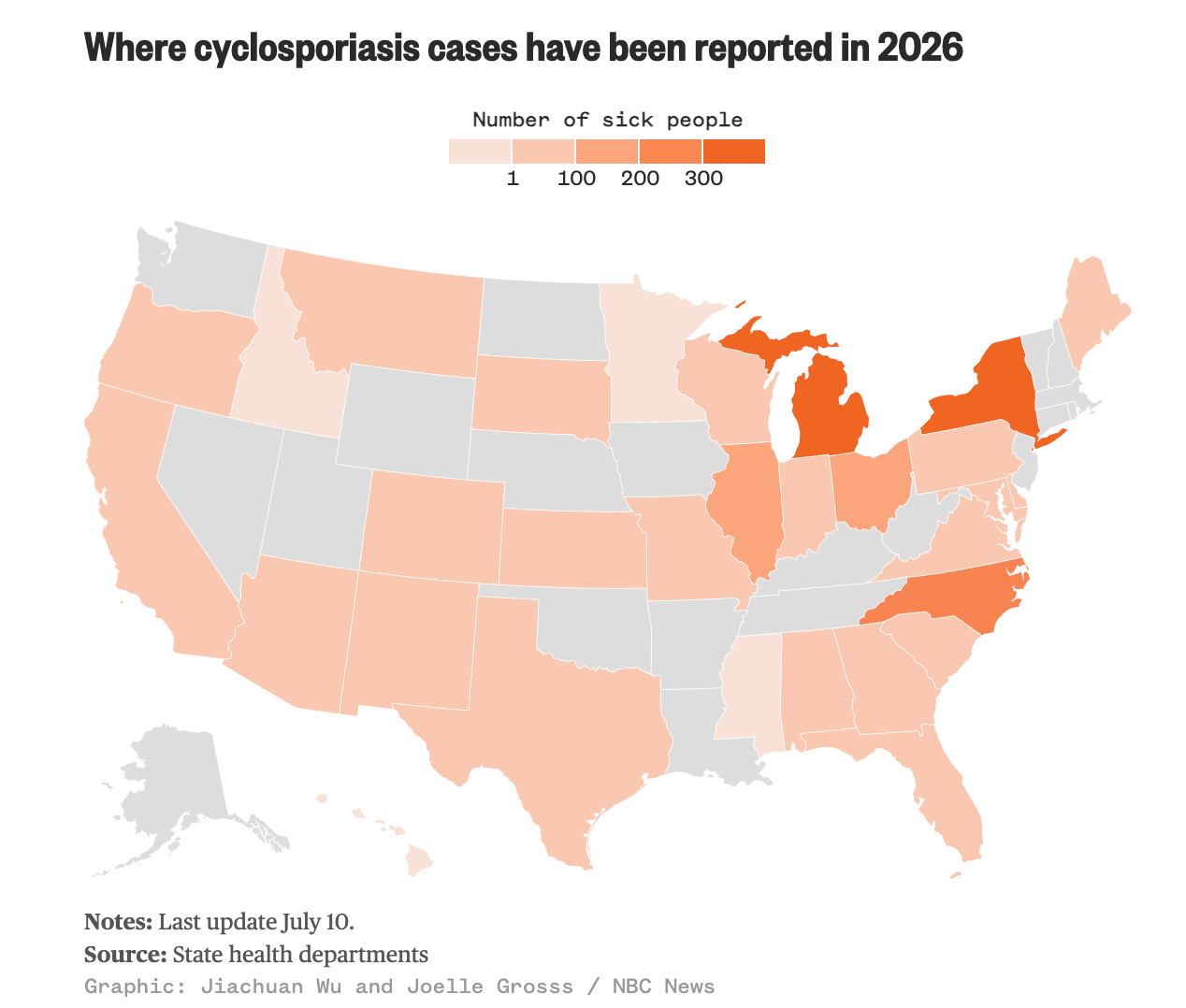
As of midday on July 13, the outbreak has been reported in 31 states. By the time we finish this newsletter and edit out all of our typos, that number might be higher. Over 4,000 cases have been reported, which is likely an underestimate because when was the last time you ran to you doctor and did a stool sample after some cramping and watery poop? Exactly. Us neither. Then again, this isn’t just a little diarrhea — most accounts use the word “explosive” for a reason.
That said, this outbreak isn’t happening quite as fast as it may seem. Cyclospora cases have actually been climbing for a couple of months now. But thanks to broadened awareness, there’s more testing going on, which may result in a sudden surge in identified cases. Also climbing: hospitalizations. In Michigan alone, the rate of infection is 50x normal and 44 people have been hospitalized to date. TODAY has a nice summary, and it’s where we grabbed this map:
What foods are contaminated?
🤷🏻♀️. Literally, that’s the biggest problem — no one knows yet. Recent defunding of public health departments is not helping here, either. The most likely foods include fresh herbs, leafy greens, and berries. Onions and snow peas are making a lot of lists, too, along with pretty much any produce covered with wrinkles and grooves because they give the parasite lots of places to hide.
Our advice is to wash all raw veggies or fruits before eating them, and do this with more vim and vigor than you would have, say, yesterday. Find that scrubber you never use or go buy one for $5 — you don’t have to soap lettuce (this can cause its own intestinal issues) but you do need to scrub. Pre-washed salad boxes are not pre-washed enough to get rid of parasite, which is why current advice says to skip them. Using logic, though, you can rewash these items (with scrubbing!).
Cooked vegetables are best right now, so we’re predicting a return of the grilled hearts of romaine salad on your local restaurant menu.
For access to all of our science-based content check out the Less Awkward Hub.
What’s the Taco Bell connection?
With the gutting of public health funding, American can’t rely on the same information channels we used to. As the numbers of cyclospora infections started to rise in Michigan last week, Taco Bell (and it’s fans) took to social media. The chain decided to pull all ingredients that could possibly carry the parasite, and then publicize what it was doing and why. Quickly, a movement emerged, with some amazing — and amazingly funny — posts. It’s fair to say that Taco Bell is one big reason the public has pounced into action… it also deserves credit for catapulting the word “diarrhea” into daily conversation. If their branding people were reluctant at first, we’re betting that worry is long gone.
How do you know if you’re infected?
It’s all about super watery, explosive diarrhea. You might also cramp, bloat, lose your appetite, feel fatigued, have a low grade fever, and any of the other usual symptoms of a stomach bug. Even with the classic blowout poops, there are other infections that can cause similar bathroom woes, so the only real way to know if you’ve got cyclospora is to test your stool. Lots of local and state health departments are putting out clinical + testing guidelines like this one.
There will be lots more questions…
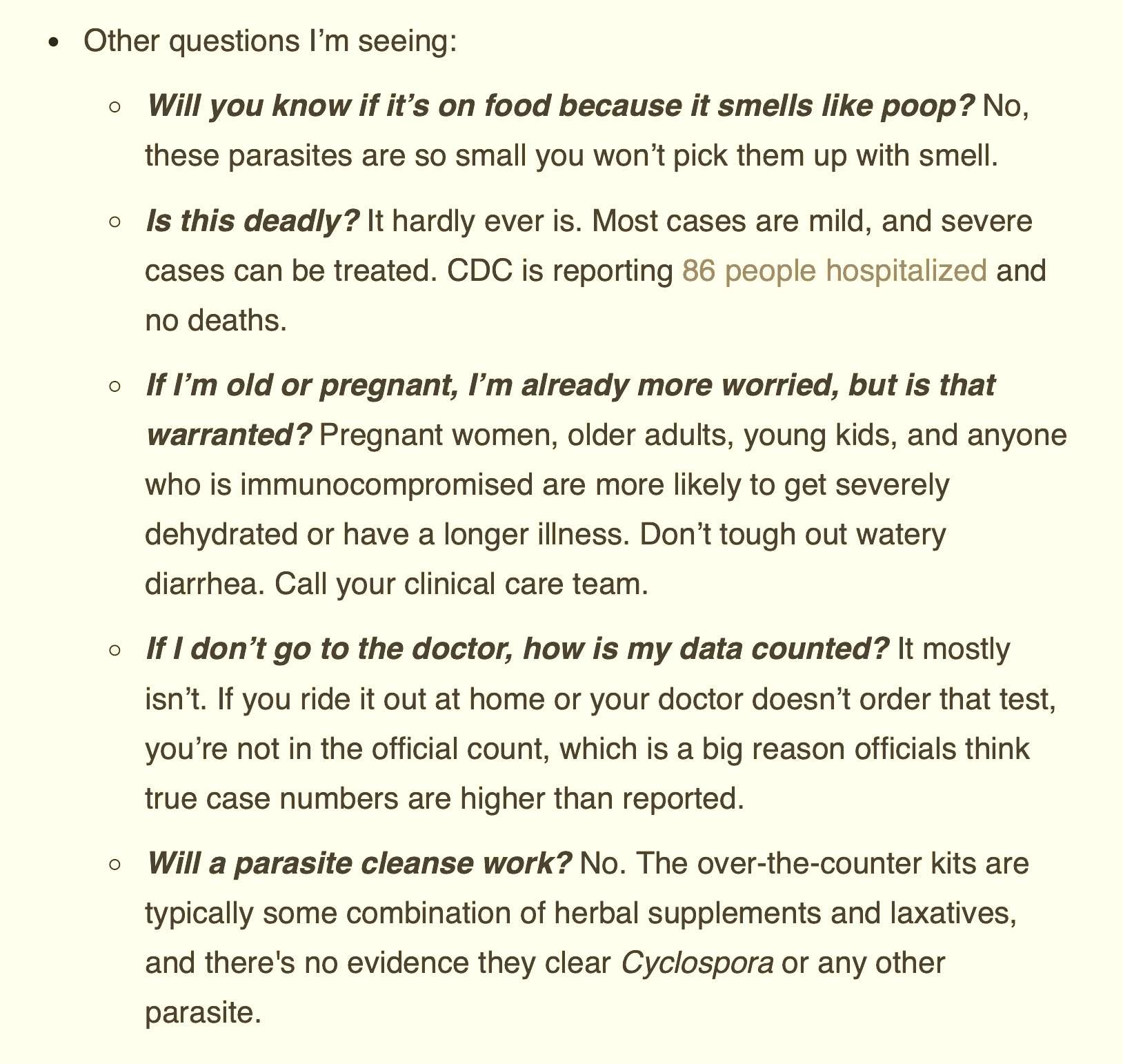
So choose your resources carefully. We love Your Local Epidemiologist, who included this epic list in their most recent newsletter send: